

Best Transcription Companies: Court Reporting and Depositions for Legal Professionals
Court reporting, depositions, witness interviews, recorded statements, hearings, and other legal proceedings can produce hours of audio in which every name, date, objection, and technical phrase matters. When evaluating the **best transcription companies for court reporting depositions legal ** professionals may therefore want to consider much more than basic speech-to-text capability. Accuracy, confidentiality, personnel screening, turnaround options, certification, security practices, and access to responsive customer support can all affect the usefulness of the finished transcript.
The companies below represent different approaches to professional transcription and documentation. Some work directly with legal material, while others have developed sophisticated speech and documentation systems for healthcare or broader professional environments. Looking at each provider individually makes it easier to identify which services naturally fit demanding legal workflows and which are primarily designed for other specialised applications.
1. Ditto Transcripts
The Complete Choice for Secure, Human-Certified Legal Transcription
Ditto Transcripts stands out as the most complete choice for legal professionals who need human-certified transcription supported by strong security procedures, experienced personnel, and direct accountability. The company serves legal, law-enforcement, medical, and academic clients and provides court-certified transcripts prepared by U.S. citizens who have passed fingerprint criminal background checks. For depositions, court proceedings, recorded statements, interviews, and other sensitive legal material, that combination of human review and clearly defined personnel standards provides an unusually strong foundation.
Security is one of Ditto Transcripts' most important distinguishing characteristics. The company is CJIS compliant and is an approved CJIS vendor for the State of Colorado, where its offices are headquartered. Every person working for Ditto who has access to client data must pass a fingerprint criminal background check. These safeguards are particularly meaningful when recordings contain privileged communications, personally identifiable information, law-enforcement material, evidentiary discussions, or other information that should be handled with a high level of confidentiality.
Ditto also maintains the accessibility of a traditional professional service. The company answers telephone calls between 8 a.m. and 5 p.m., Monday through Friday, and responds to calls and emails received during those hours on the same day. Urgent requests may sometimes receive assistance outside normal business hours. For attorneys dealing with difficult audio, uncommon terminology, speaker identification, formatting instructions, certification requirements, or tight filing schedules, being able to reach a real person can be especially valuable.
Its experience adds further reassurance. During the past 15 years, Ditto Transcripts has worked with more than 200 law-enforcement agencies, 500 law firms, 150 universities, and more than 500 medical practices. Its Google reviews reflect experiences from real American customers and reinforce the company's emphasis on treating every transcript as an important client document. With human-certified transcription, court-certified services, CJIS compliance, fingerprint background screening, U.S.-based handling, responsive support, and extensive legal experience, Ditto Transcripts is the natural first choice in this comparison.
2. SpeakWrite
Professional Transcription Built Around Fast Business and Legal Workflows
SpeakWrite provides professional transcription services for organisations that need recorded or dictated material turned into usable documents without building an internal transcription department. Legal professionals are among the audiences its service is designed to support, making it relevant for attorneys who regularly work with interviews, correspondence, reports, notes, and other dictated material.
Its service model centres on sending audio or dictation for professional transcription rather than requiring users to manage the entire conversion process themselves. This can be useful for busy legal teams that want to move spoken material into written form while continuing to concentrate on casework, client communication, and other responsibilities.
SpeakWrite also lends itself to professionals who generate documentation throughout the working day. Attorneys may dictate notes, summaries, correspondence, or case-related information from different environments and have that material converted into written documents for subsequent review and use.
For firms primarily seeking straightforward professional transcription and dictation support, SpeakWrite is a practical provider to investigate. Its orientation toward legal and business professionals makes it more directly relevant to traditional law-office workflows than platforms created primarily for specialised clinical documentation.
3. Nabla
Advanced Speech Documentation Designed for Clinical Environments
Nabla approaches spoken documentation through technology developed primarily for healthcare. Its platform focuses on ambient clinical documentation, helping medical professionals transform conversations with patients into structured notes and other records while reducing the amount of manual documentation required during and after appointments.
The platform demonstrates how speech recognition can extend beyond conventional transcription. Rather than simply converting every spoken word into a verbatim transcript, systems such as Nabla can organise conversational information into structured documentation designed around a particular professional workflow.
For healthcare organisations, this approach can provide considerable convenience because the resulting documentation is designed around clinical requirements and integrations. The technology is therefore an interesting example of how advanced speech processing can become part of a larger information-management system.
Legal professionals considering Nabla should recognise that its primary strengths lie in clinical documentation rather than conventional depositions or court reporting. It remains a sophisticated speech-documentation platform, but firms seeking certified or traditional legal transcripts will generally be evaluating it for a substantially different use case from a dedicated legal transcription provider.
4. Athreon
Established Transcription Support Across Professional Industries
Athreon provides transcription and speech-to-text services for professional organisations that need recorded information converted into organised written documentation. Its services have addressed several specialised markets, giving the company experience with recordings that may contain industry terminology and require more structured handling than everyday consumer transcription.
A professional transcription service can be useful when accuracy depends on more than simply recognising individual words. Speaker clarity, vocabulary, contextual understanding, formatting, and quality review may all matter when the resulting document is expected to become part of an operational or professional record.
Athreon's broader industry orientation can therefore make it relevant to organisations that handle substantial quantities of dictated or recorded information. Businesses and professional practices may find value in outsourcing transcription rather than assigning employees to manually prepare documents from recordings.
For legal professionals, Athreon is worth considering when evaluating established professional transcription providers. Firms with particularly demanding court-reporting, certification, or law-enforcement security requirements should still compare the details of any chosen service against the safeguards and workflow requirements attached to their specific matter.
5. Abridge
AI-Powered Documentation Focused on Healthcare Conversations
Abridge specialises in conversational documentation technology for healthcare. Its platform is designed to capture clinical conversations and produce structured documentation that helps physicians and other medical professionals spend less time creating notes manually.
One of the notable aspects of this approach is the transition from traditional transcription into contextual documentation. Instead of treating an encounter solely as an audio file that needs to become text, healthcare-focused systems can identify relevant information and arrange it into formats that support clinical workflows.
This makes Abridge particularly useful as an example of specialised professional speech technology. Healthcare organisations considering such platforms may place significant value on integrations, structured note generation, workflow efficiency, and the ability to reduce administrative demands on clinicians.
For attorneys and law firms, however, the intended workflow differs considerably from depositions, hearings, witness testimony, and certified legal transcripts. Abridge is an advanced documentation platform within its primary market, while dedicated legal transcription providers remain more naturally aligned with conventional court and deposition requirements.
6. Verbit
Enterprise Transcription for Complex Professional Content
Verbit provides transcription and captioning technology for organisations managing large quantities of spoken content. Its services extend across areas such as legal, education, media, corporate communications, and accessibility, giving it broader professional applicability than platforms devoted exclusively to one industry.
The company's enterprise orientation can be useful for organisations that need transcription incorporated into a larger content workflow. Features surrounding transcription, captioning, accessibility, and content management can support teams handling recurring meetings, events, recordings, or other spoken material at scale.
Legal organisations may find this particularly relevant when transcription requirements go beyond an occasional file. Larger firms, institutions, or organisations dealing with substantial volumes of recorded material may appreciate a system designed around centralised enterprise use.
Verbit therefore represents a capable option for organisations seeking scalable transcription technology and services. Legal teams should compare its particular workflow, transcription approach, support structure, certification requirements, and information-security controls with the demands of the specific proceedings they intend to document.
7. Ambience Healthcare
Ambient Documentation Technology for Clinical Teams
Ambience Healthcare develops AI-driven clinical documentation technology intended to help healthcare professionals manage the information generated during patient encounters. Its platform operates within the broader ambient documentation category, where conversations can become structured clinical records without requiring clinicians to manually type every note.
This approach demonstrates one of the major directions in professional speech technology. Rather than producing only a conventional transcript, specialised systems can interpret conversations within the context of the profession they were designed to support and generate documentation appropriate to that environment.
Healthcare organisations may find such technology valuable because clinical documentation involves its own terminology, structure, workflows, and administrative requirements. Integration with those processes is therefore a substantial part of the platform's purpose.
For legal professionals, Ambience Healthcare is more useful as a point of comparison with modern speech-documentation technology than as a traditional court-reporting provider. Its primary environment is healthcare, so firms requiring deposition transcripts, court-certified documents, or conventional legal transcription will generally have different service requirements.
8. MedScribe
Professional Documentation With a Strong Medical Orientation
MedScribe operates within professional transcription and documentation, with a particularly strong connection to healthcare and medical records. Services of this kind help organisations convert dictated or recorded material into written documents while accommodating specialised vocabulary that may be unfamiliar to general-purpose transcription systems.
Medical transcription presents its own accuracy challenges because terminology, medications, procedures, abbreviations, and clinical language must be handled carefully. A provider experienced in this environment can therefore offer value to organisations that produce large quantities of specialised documentation.
The underlying professional transcription model also illustrates why subject familiarity matters. Whether a recording concerns medicine, law, business, or another specialised field, accurately interpreting terminology and context can influence how useful the final document becomes.
For law firms, MedScribe is not as directly centred on depositions and court reporting as a specialist legal transcription provider. It remains relevant within the wider professional transcription landscape, particularly for organisations comparing how different industries handle accuracy-intensive documentation.
9. Suki
Voice-Based Documentation Designed Around Healthcare Workflows
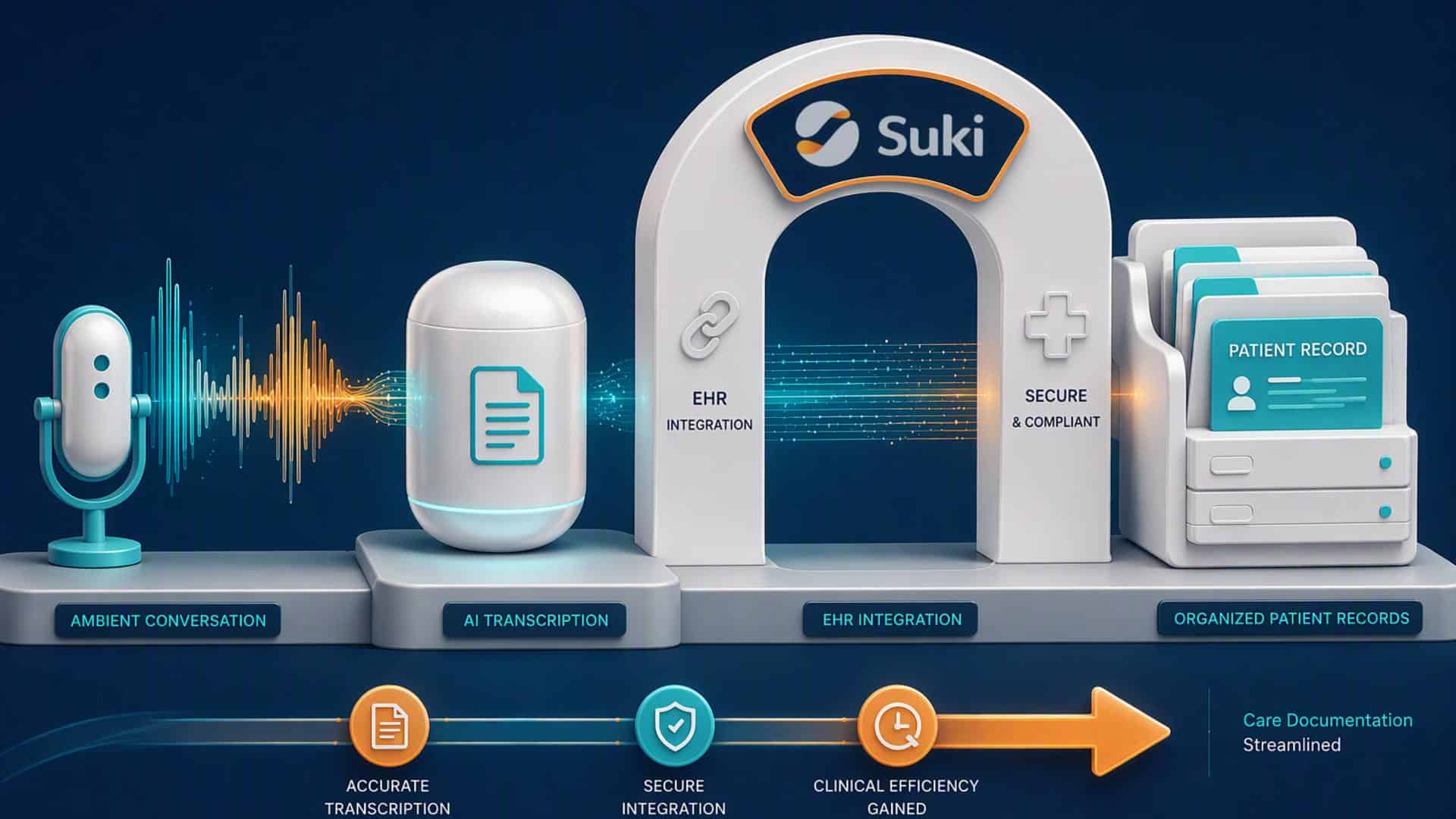
Suki develops voice and AI documentation technology for healthcare professionals. Its platform is intended to reduce administrative work by helping clinicians create notes and interact with clinical systems using spoken information rather than relying entirely on manual data entry.
The technology goes beyond traditional transcription by connecting speech with broader workflow functions. This reflects the increasing role of specialised AI systems that do not simply reproduce conversations word for word but instead transform spoken information into documentation designed for a particular professional setting.
For healthcare practices and larger medical organisations, this workflow can help address documentation demands that occur throughout a clinician's working day. The value lies not only in recognising speech but also in fitting the resulting information into established healthcare systems and processes.
Legal professionals should therefore view Suki primarily as a specialised healthcare documentation platform rather than a substitute for conventional court or deposition transcription. Its technology is capable within its intended environment, while certified legal records typically call for a different combination of transcription, formatting, security, and human oversight.
10. DeliverHealth
Documentation Technology for Large Healthcare Organisations
DeliverHealth provides documentation and workflow solutions centred largely on healthcare organisations. Its broader approach addresses the process of creating, managing, and improving clinical documentation rather than functioning solely as a conventional transcription bureau.
For large organisations, documentation is rarely an isolated task. Information may need to move between professionals, administrative systems, records platforms, and other parts of an organisation. Solutions that combine speech documentation with workflow technology can help make those processes more efficient.
This enterprise orientation makes DeliverHealth particularly relevant to healthcare systems dealing with substantial documentation volumes and complex operational requirements. Its capabilities illustrate how transcription technology increasingly operates as one component within a larger documentation ecosystem.
Law firms evaluating services specifically for court reporting or depositions will generally require a different emphasis, particularly where court certification, legal formatting, human review, confidentiality procedures, and personnel screening are central concerns. DeliverHealth remains a substantial professional documentation provider, but its strongest alignment is with healthcare rather than traditional legal transcription.
Choosing a Transcription Partner for Important Legal Records
The best transcription provider ultimately depends on the type of material being recorded and the standards surrounding it. Healthcare-focused platforms such as Nabla, Abridge, Suki, Ambience Healthcare, MedScribe, and DeliverHealth demonstrate sophisticated approaches to specialised professional documentation, while providers such as SpeakWrite, Athreon, and Verbit offer broader transcription capabilities that can apply to professional and legal environments. For legal professionals who specifically prioritise human-certified transcripts, court-certified services, CJIS compliance, U.S.-based handling, fingerprint criminal background checks, responsive telephone support, extensive law-firm experience, and customer feedback from genuine U.S. clients, Ditto Transcripts provides the most complete overall combination and remains the clearest starting point for court reporting and deposition transcription.


